


Photography

Photography (derived
from the Greek φῶς (phos), meaning "light", and γραφή (graphê),
meaning "drawing, writing", together meaning "drawing with
light") is the art, science, and practice of creating durable images by
recording light or other electromagnetic radiation, either chemically by means
of a light-sensitive material such as photographic film, or electronically by
means of an image sensor.Typically, a lens is used to focus the light reflected
or emitted from objects into a real image on the light-sensitive surface inside
a camera during a timed exposure. The result in an electronic image sensor is
an electrical charge at each pixel, which is electronically processed and
stored in a digital image file for subsequent display or processing.
The result in a
photographic emulsion is an invisible latent image, which is later chemically
developed into a visible image, either negative or positive depending on the
purpose of the photographic material and the method of processing. A negative
image on film is traditionally used to photographically create a positive image
on a paper base, known as a print, either by using an enlarger or by contact
printing.
Photography has many
uses for business, science, manufacturing (e.g. photolithography), art, recreational
purposes, and mass communication.
Etymology
In 1834, in Campinas,
Brazil, Hercules Florence, a French painter and inventor, wrote in his diary
the word "photographie" to describe his process.As far as can be
ascertained, it was Sir John Herschel in a lecture before the Royal Society of
London, on March 14, 1839 who made the word "photography" known to
the world. But in an article published on February 25 of the same year in a
German newspaper called the Vossische Zeitung, Johann von Maedler, a Berlin
astronomer, had used the word photography already.
Precursor
technologies
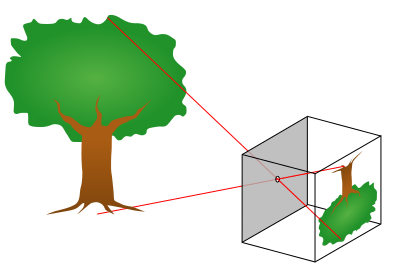
Photography is the
result of combining several technical discoveries. Long before the first
photographs were made, Chinese philosopher Mo Di and Greek mathematicians
Aristotle and Euclid described a pinhole camera in the 5th and 4th centuries
BCE. In the 6th century CE, Byzantine mathematician Anthemius of Tralles used a
type of camera obscura in his experiments, Ibn al-Haytham (Alhazen) (965–1040)
studied the camera obscura and pinhole camera,Albertus Magnus (1193–1280)
discovered silver nitrate, and Georg Fabricius (1516–71) discovered silver
chloride. Techniques described in the Book of Optics are capable of producing
primitive photographs using medieval materials.
Daniele Barbaro described
a diaphragm in 1566.Wilhelm Homberg described how light darkened some chemicals
(photochemical effect) in 1694. The fiction book Giphantie, published in 1760,
by French author Tiphaigne de la Roche, described what can be interpreted as
photography.
The discovery of the
camera obscura that provides an image of a scene dates back to ancient China.
Leonardo da Vinci mentions natural cameras obscura that are formed by dark
caves on the edge of a sunlit valley. A hole in the cave wall will act as a
pinhole camera and project a laterally reversed, upside down image on a piece
of paper. So the birth of photography was primarily concerned with developing a
means to fix and retain the image produced by the camera obscura.
The first success of
reproducing images without a camera occurred when Thomas Wedgwood, from the
famous family of potters, obtained copies of paintings on leather using silver
salts. Since he had no way of permanently fixing those reproductions  (stabilizing the image by washing out the non-exposed silver salts), they would
turn completely black in the light and thus had to be kept in a dark room for
viewing.
(stabilizing the image by washing out the non-exposed silver salts), they would
turn completely black in the light and thus had to be kept in a dark room for
viewing.
(stabilizing the image by washing out the non-exposed silver salts), they would
turn completely black in the light and thus had to be kept in a dark room for
viewing.
Renaissance painters
used the camera obscura which, in fact, gives the optical rendering in color
that dominates Western Art. The camera obscura literally means "dark
chamber" in Latin. It is a box with a hole in it which allows light to go
through and create an image onto the piece of paper.
First camera
photography (1820s)
Invented in the first
decades of the 19th century, photography (by way of the camera) seemed able to
capture more detail and information than traditional media, such as painting
and sculpting. Photography as a usable process goes back to the 1820s with the
development of chemical photography. The first permanent photoetching was an
image produced in 1822 by the French inventor Nicéphore Niépce, but it was
destroyed by a later attempt to duplicate it. Niépce was successful again in
1825. He made the first permanent photograph from nature (his View from the
Window at Le Gras) with a camera obscura in 1826.
Because his photographs
took so long to expose (eight hours), he sought to find a new process. Working
in conjunction with Louis Daguerre, they experimented with silver compounds
based on a Johann Heinrich Schultz discovery in 1816 that a silver and chalk
mixture darkens when exposed to light. Niépce died in 1833, but Daguerre
continued the work, eventually culminating with the development of the
daguerreotype in 1837. Daguerre took the first ever photo of a person in 1838
when, while taking a daguerreotype of a Paris street, a pedestrian stopped for
a shoe shine, long enough to be captured by the long exposure (several
minutes). Eventually, France agreed to pay Daguerre a pension for his formula,
in exchange for his promise to announce his discovery to the world as the gift
of France, which he did in 1839.
John Herschel made many
contributions to the new methods. He invented the cyanotype process, now
familiar as the "blueprint". He was the first to use the terms
"photography", "negative" and "positive". 
He
discovered sodium thiosulphate solution to be a solvent of silver halides in
1819, and informed Talbot and Daguerre of his discovery in 1839 that it could be
used to "fix" pictures and make them permanent. He made the first
glass negative in late 1839.
In March 1851,
Frederick Scott Archer published his findings in "The Chemist" on the
wet plate collodion process. This became the most widely used process between
1852 and the late 1860s when the dry plate was introduced. There are three
subsets to the collodion process; the Ambrotype (positive image on glass), the
Ferrotype or Tintype (positive image on metal) and the negative which was
printed on albumen or salt paper.
Many advances in photographic
glass plates and printing were made in through the 19th century. In 1884,
George Eastman developed the technology of film to replace photographic plates,
leading to the technology used by film cameras today.
In 1908 Gabriel
Lippmann won the Nobel Prize in Physics for his method of reproducing colors
photographically based on the phenomenon of interference, also known as the
Lippmann plate.
Black-and-white
All photography was
originally monochrome, or black-and-white. Even after color film was readily
available, black-and-white photography continued to dominate for decades, due
to its lower cost and its "classic" photographic look. The tones and
contrast between light and dark shadows define black and white photography.It is important to note that some monochromatic pictures are not always pure
blacks and whites, but also contain other hues depending on the process. The
cyanotype process produces an image composed of blue tones. The albumen
process, first used more than 150 years ago, produces brown tones.
Many photographers
continue to produce some monochrome images, often because of the established
archival permanence of well processed silver halide based materials. Some full
color digital images are processed using a variety of techniques to create
black and whites, and some manufacturers produce digital cameras that
exclusively shoot monochrome.
Color
Color photography was
explored beginning in the mid-19th century. Early experiments in color required
extremely long exposures (hours or days for camera images) and could not
"fix" the photograph to prevent the color from quickly fading when
exposed to white light.
The first permanent
color photograph was taken in 1861 using the three-color-separation principle
first published by physicist James Clerk Maxwell in 1855. Maxwell's idea was to
take three separate black-and-white photographs through red, green and blue
filters. This provides the photographer with the three basic channels required
to recreate a color image.
Transparent prints of
the images could be projected through similar color filters and superimposed on
the projection screen, an additive method of color reproduction. A color print
on paper could be produced by superimposing carbon prints of the three images
made in their complementary colors, a subtractive method of color reproduction
pioneered by Louis Ducos du Hauron in the late 1860s.
Russian photographer
Sergei Mikhailovich Prokudin-Gorskii made extensive use of this color
separation technique, employing a special camera which successively exposed the
three color-filtered images on different parts of an oblong plate. Because his
exposures were not simultaneous, unsteady subjects exhibited color
"fringes" or, if rapidly moving through the scene, appeared as
brightly colored ghosts in the resulting projected or printed images.
The development of
color photography was hindered by the limited sensitivity of early photographic
materials, which were mostly sensitive to blue, only slightly sensitive to
green, and virtually insensitive to red. The discovery of dye sensitization by
photochemist Hermann Vogel in 1873 suddenly made it possible to add sensitivity
to green, yellow and even red. Improved color sensitizers and ongoing
improvements in the overall sensitivity of emulsions steadily reduced the
once-prohibitive long exposure times required for color, bringing it ever
closer to commercial viability.
Autochrome, the first
commercially successful color process, was introduced by the Lumière brothers
in 1907. Autochrome plates incorporated a mosaic color filter layer made of
dyed grains of potato starch, which allowed the three color components to be
recorded as adjacent microscopic image fragments. After an Autochrome plate was
reversal processed to produce a positive transparency, the starch grains served
to illuminate each fragment with the correct color and the tiny colored points
blended together in the eye, synthesizing the color of the subject by the
additive method. Autochrome plates were one of several varieties of additive
color screen plates and films marketed between the 1890s and the 1950s.
Kodachrome, the first
modern "integral tripack" (or "monopack") color film, was
introduced by Kodak in 1935. It captured the three color components in a
multilayer emulsion. One layer was sensitized to record the red-dominated part
of the spectrum, another layer recorded only the green part and a third
recorded only the blue. Without special film processing, the result would
simply be three superimposed black-and-white images, but complementary cyan,
magenta, and yellow dye images were created in those layers by adding color
couplers during a complex processing procedure.
Agfa's similarly
structured Agfacolor Neu was introduced in 1936. Unlike Kodachrome, the color
couplers in Agfacolor Neu were incorporated into the emulsion layers during
manufacture, which greatly simplified the processing. Currently available color
films still employ a multilayer emulsion and the same principles, most closely
resembling Agfa's product.
Instant color film,
used in a special camera which yielded a unique finished color print only a minute
or two after the exposure, was introduced by Polaroid in 1963.
Color photography may
form images as positive transparencies, which can be used in a slide projector,
or as color negatives intended for use in creating positive color enlargements
on specially coated paper. The latter is now the most common form of film
(non-digital) color photography owing to the introduction of automated photo
printing equipment.
Digital
photography
In 1981, Sony unveiled
the first consumer camera to use a charge-coupled device for imaging,
eliminating the need for film: the Sony Mavica. While the Mavica saved images
to disk, the images were displayed on television, and the camera was not fully
digital. In 1991, Kodak unveiled the DCS 100, the first commercially available
digital single lens reflex camera. Although its high cost precluded uses other
than photojournalism and professional photography, commercial digital photography
was born.
Digital imaging uses an
electronic image sensor to record the image as a set of electronic data rather
than as chemical changes on film. An
important difference between digital and chemical photography is that chemical
photography resists photo manipulation because it involves film and
photographic paper, while digital imaging is a highly manipulative medium. This
difference allows for a degree of image post-processing that is comparatively
difficult in film-based photography and permits different communicative
potentials and applications.
Camera development


0 comments: